
200 Series LandCruiser Touring Fitout — Geelong
Brief: 200 Series Touring Fitout ·
Customer: Chris C Geelong ·
Build duration: 5 days ·
Read time: 7 min
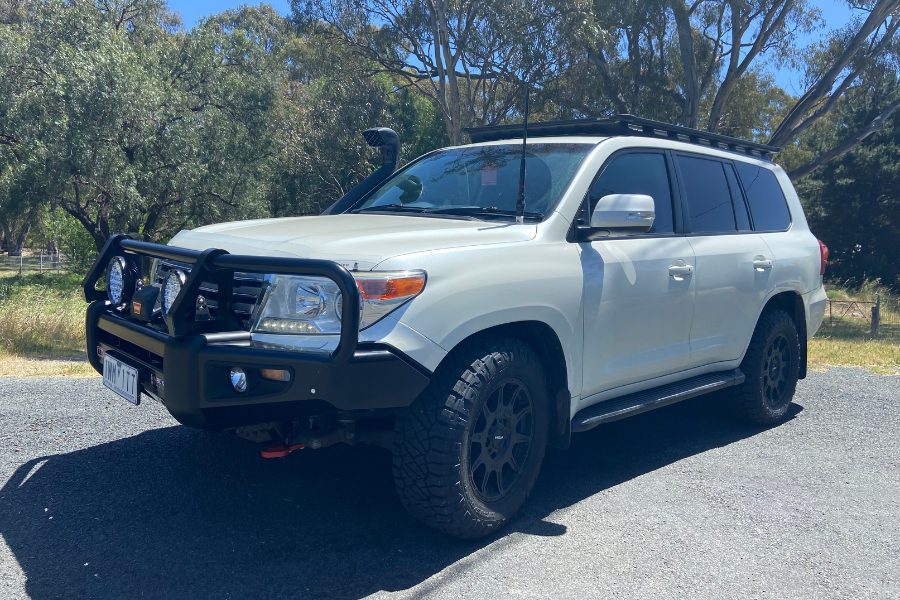
When a bloke from Geelong rings me to fit out his 200 Series in the Bendigo workshop, I take it as a compliment. It usually means I’ve earned a bit of trust on a smaller job first, and the bigger build has followed from there. That’s exactly how Chris’s earlier-model 200 Series LandCruiser ended up in front of me, and why he and his wife were happy to make the round trip up to collect it.
The relationship started on a winch. A long-standing customer of mine put Chris onto me to service the Warn low-mount winch in his old 100 Series. The winch came in, got the full service, went back out. We got talking. Chris mentioned he was thinking about selling the 100 and stepping into something a bit more comfortable for him and the missus — but still capable enough that he wouldn’t worry about taking it into the bush. That conversation opened the door to everything else on this build.
What landed in the workshop later was an earlier 200 Series, and that was a deliberate choice. Chris didn’t want brand new. He wanted a vehicle that already had a few years on it so he could fit it out properly, use it hard and not be precious about every stone chip down a fire trail. For a serious tourer who knows what they’re doing, that’s a sensible call — and it’s the kind of decision that lets a build like this make sense financially.
From 100 Series to 200 Series — Why Chris Made the Step
There aren’t many vehicles you can step out of a 100 Series into and get the same fundamentals — a proper V8 LandCruiser platform with the room, comfort and long-distance ride that a couple needs for serious touring. The 200 ticks every one of those boxes. Once Chris had sold the 100 and started looking, I genuinely couldn’t point him at anything else in that price bracket that would do what he needed.
There was a moment in the planning phase where he had second thoughts — that’s normal on any build at this scale. He was weighing up whether tipping money into an older vehicle was the right call given resale. My honest view is that a well-spec’d 200 Series in solid condition is a ten-to-fifteen-year tourer. Once the bar’s on, the snorkel’s in, the drawers are fitted and the winch is mounted, you’re not buying for resale anymore. You’re building a vehicle you intend to keep. That perspective gave him the confidence to push the button.
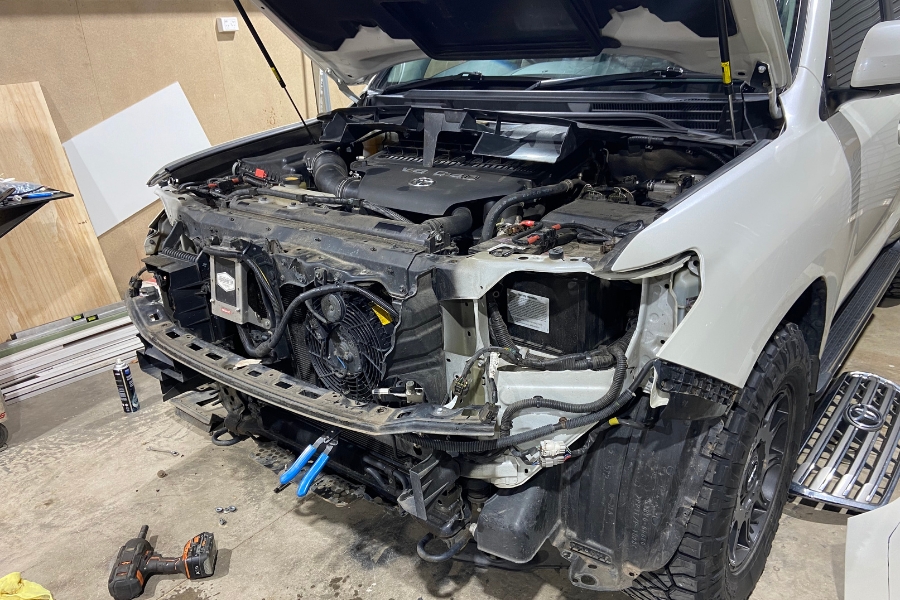
Front bumper off — the 200 stripped and prepped on the workshop floor before the ARB Deluxe Big Tube bull bar went on.
“He knew where he wanted to be. He’d done the research behind closed doors and pretty much just said — this is where I think I want to be, what are your thoughts? Most of the stuff I agreed on for sure.”
— Mitch, MBC 4X4 Solutions
What I Fitted to the Front End — Bull Bar, Recovery Points, Winch and Lights
The front-end package was the heart of this build. Chris wanted real protection, real recovery capability and decent lighting for the back-country runs he had in mind. I fitted an ARB Deluxe Big Tube bull bar — the model that pre-dates the current Summit bar — and a pair of dual rated ARB recovery points to go with it. The recovery points are an important detail. They’re ARB-engineered to handle a genuine rated load, not the bolt-on hooks you sometimes see that look the part but won’t take a real snatch when it matters.
The Deluxe Big Tube on this earlier 200 also accommodates and retains the factory headlight washers and front park sensors. That’s worth flagging because not every aftermarket bar manages both, and on a vehicle Chris uses as a daily driver as well as a tourer, keeping the factory safety gear working matters. We confirmed all that at the quote stage — it’s part of the pre-qualification process before the bar goes anywhere near the bench.
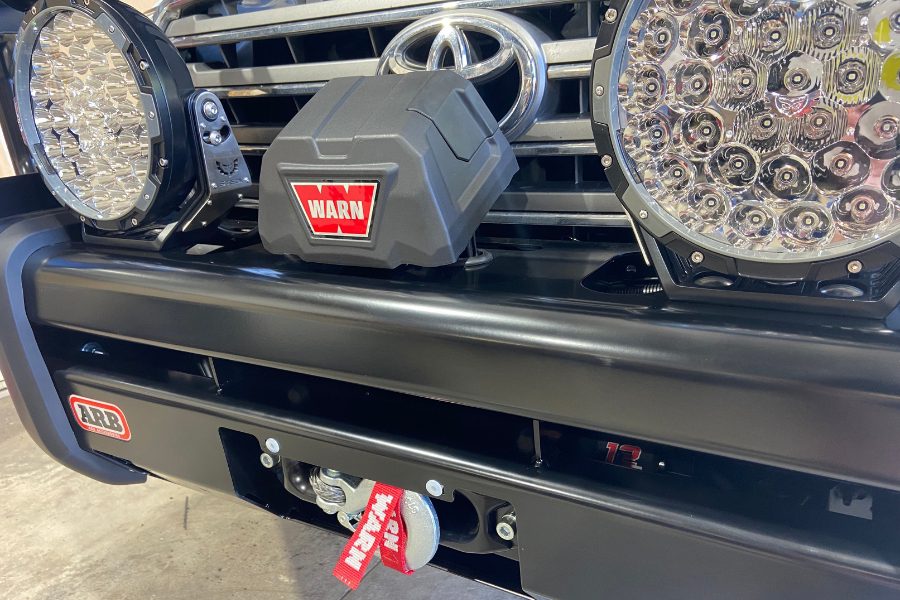
ARB Deluxe Big Tube bar with the Warn EVO 12S winch and Chris’s own 9-inch LED driving lights mounted up — fairlead, recovery points and factory grille all in place.
Behind the bar I mounted a Warn EVO 12S winch — 12,000-pound capacity — directly to the ARB winch cradle. Chris already trusted Warn from running the low-mount on his 100 Series, and there’s something to be said for sticking with kit you know. For lighting, Chris supplied his own pair of 9-inch round LED driving lights for the build. I’m always happy to fit customer-supplied gear where it’s fit for purpose, and these were a sensible match for the bar’s standard light tabs.
Planning a 200 Series or Similar Touring Build?
Tell me what you’ve got in mind — I’ll give you a straight quote across ARB, Warn, Safari, MSA, GME and more.
The Dust Problem — Why a Snorkel on Its Own Isn't Enough on a 200
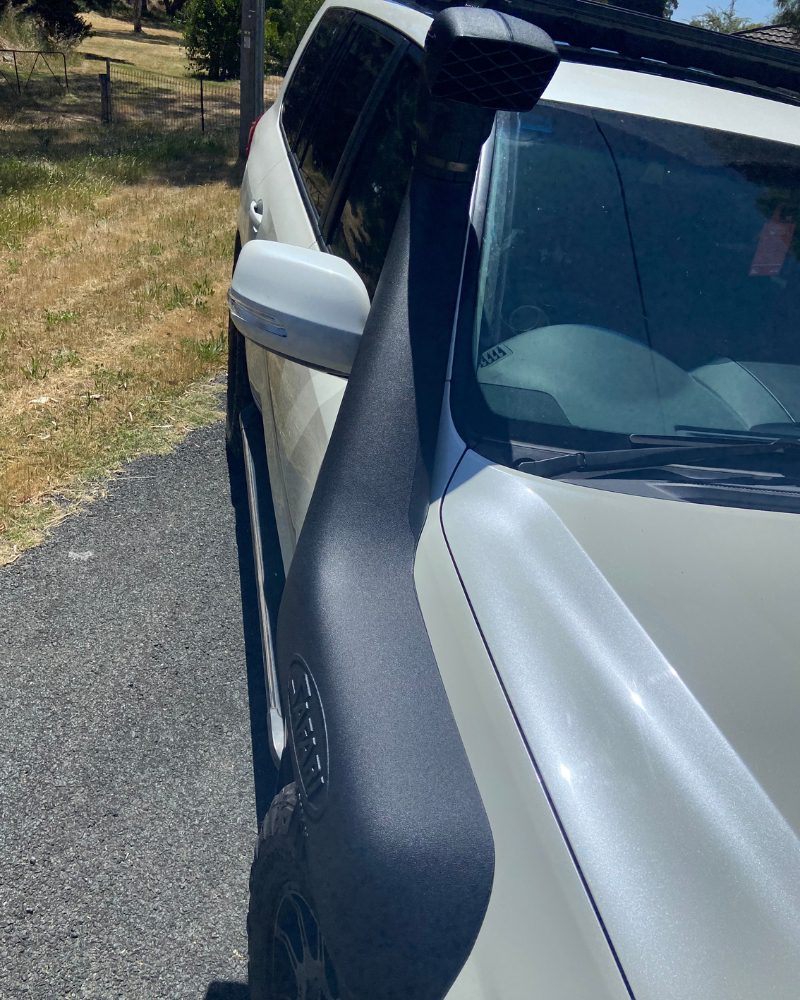
The 200 Series has a known weakness with fine dust ingestion into the airbox. A Safari Snorkel is part of the answer — it relocates the intake up to roof height where the air is cleaner — but on its own it doesn’t fix what’s happening downstream at the airbox seal. For a vehicle that’s going to spend serious time on dusty unsealed roads, snorkel-alone is a half-measure.
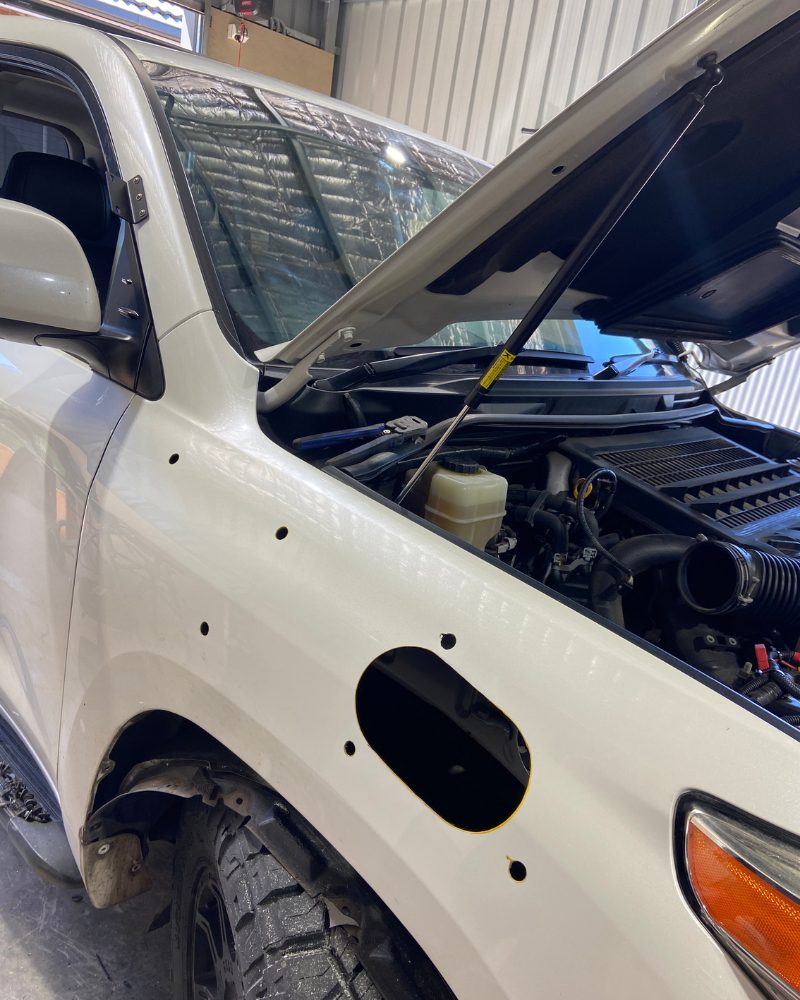
Snorkel install in progress — guard cut and mounting holes drilled for the Safari snorkel. This is the careful work that gets done before the snorkel actually goes on.
Storage, Power, Comms and Roof Work
With the front-end and air intake sorted, the rest of the build was about making the vehicle usable for the way Chris and his wife actually travel.
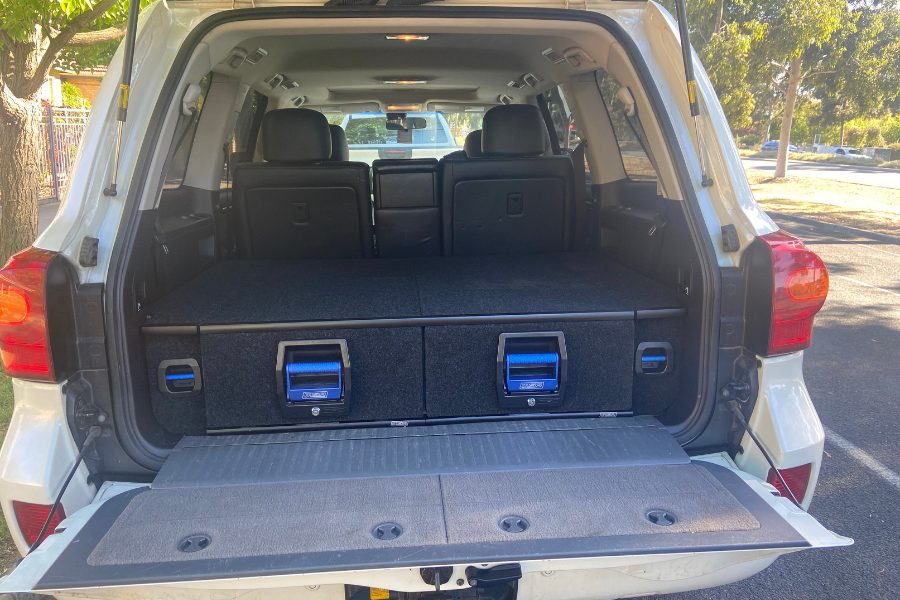
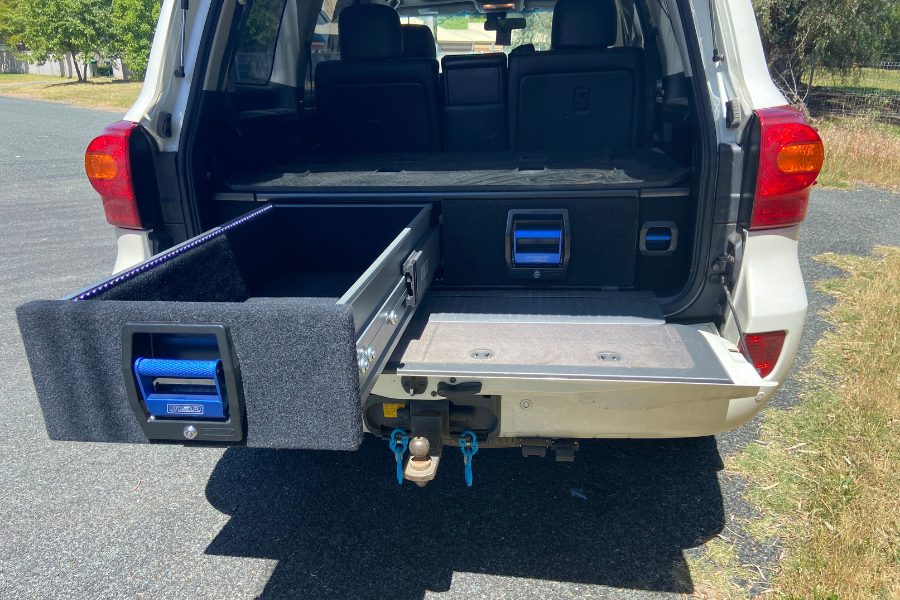
Storage came in the form of a full MSA rear drawer system — twin drawers running the length of the cargo area with a flat top deck for cargo. MSA’s a solid choice on a 200 because it’s built to suit the vehicle and finishes off neatly — it doesn’t look bolt-on. Chris went with the drawer setup that includes LED-lit interiors, which is genuinely useful when you’re sorting gear after dark at a campsite.
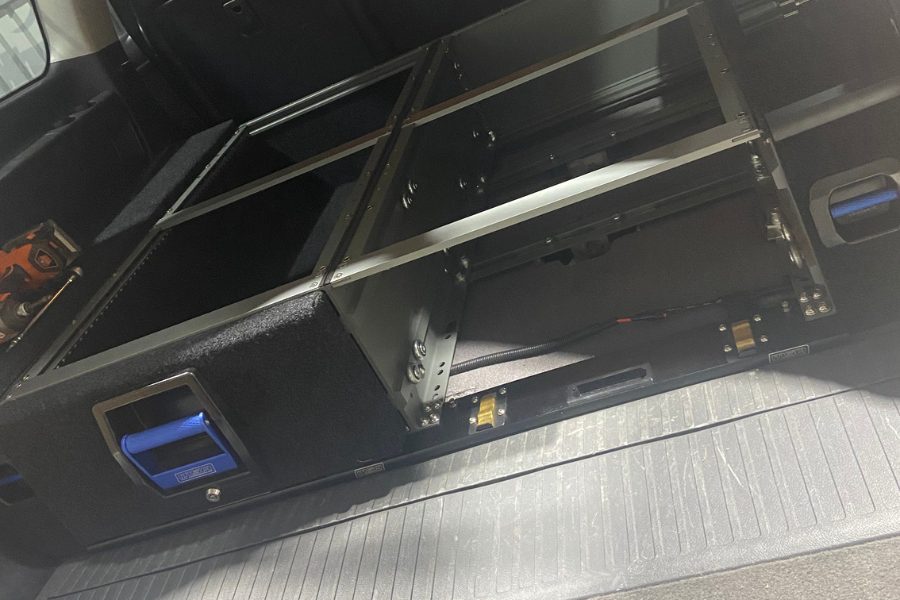
MSA drawer system going in — frame and top deck fitted, drawers being checked for action before final tie-down.
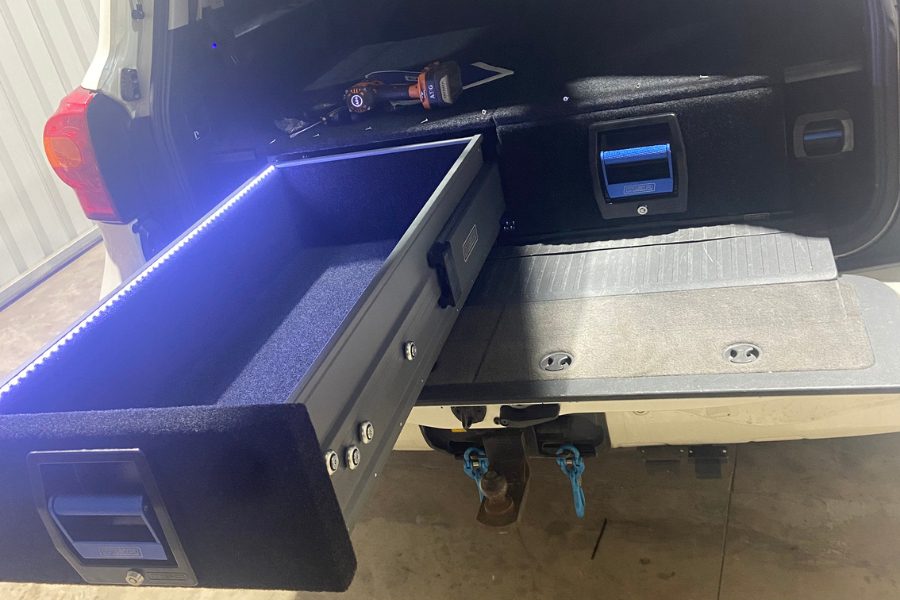
LED-lit drawer interior switched on at the install — small detail, but a real-world win at 9pm at camp.
For power I fitted an under-bonnet dual battery setup — straightforward, isolates the auxiliary load from the cranking battery and leaves room to add fridge slides, lighting or anything else down the track without going back to the wiring loom. Communications were covered by a GME aerial and a GME UHF radio with XRS — that’s basically the default UHF spec on any serious tourer right now and a no-brainer for back-country travel.
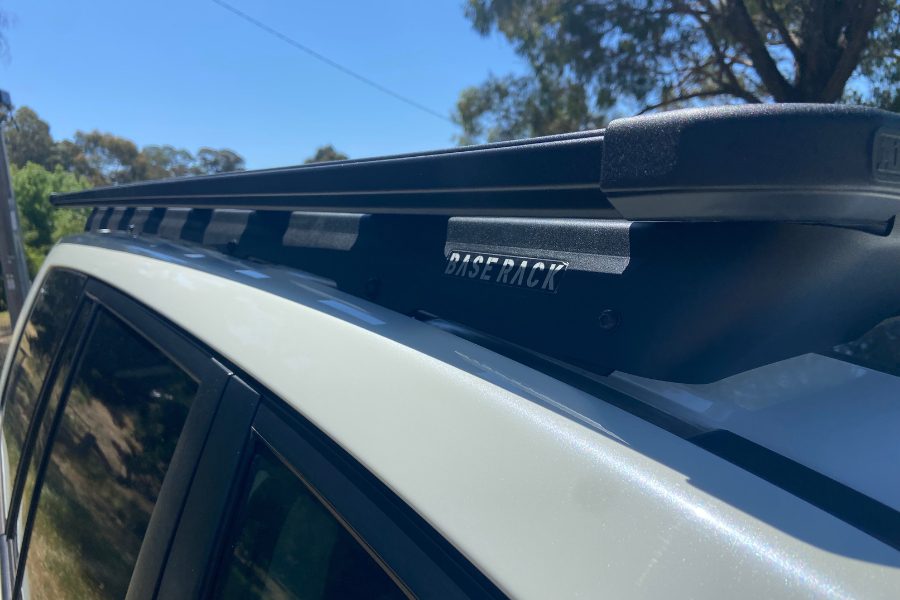
The last piece on the exterior was the ARB Base Rack roof rack. As part of fitting the Base Rack, I removed the factory Toyota roof bars — that’s standard for this rack install on a 200 Series, and we discussed it at the quote stage so there were no surprises when Chris turned up. The factory bars come off cleanly, the Base Rack sits low and tidy, and you end up with a proper load platform without the wind noise of factory crossbars over highway speeds.
The Drive From Geelong — And Why It's Worth It
Geelong to Bendigo is about two and a half hours each way. That’s not a trivial drive to drop a vehicle off for a fitout, but for Chris it was an easy call once he’d thought it through. He’d asked me who I’d recommend down his way, and I couldn’t put my hand on my heart and point him at anyone I had real confidence in. A road trip up was the obvious answer.
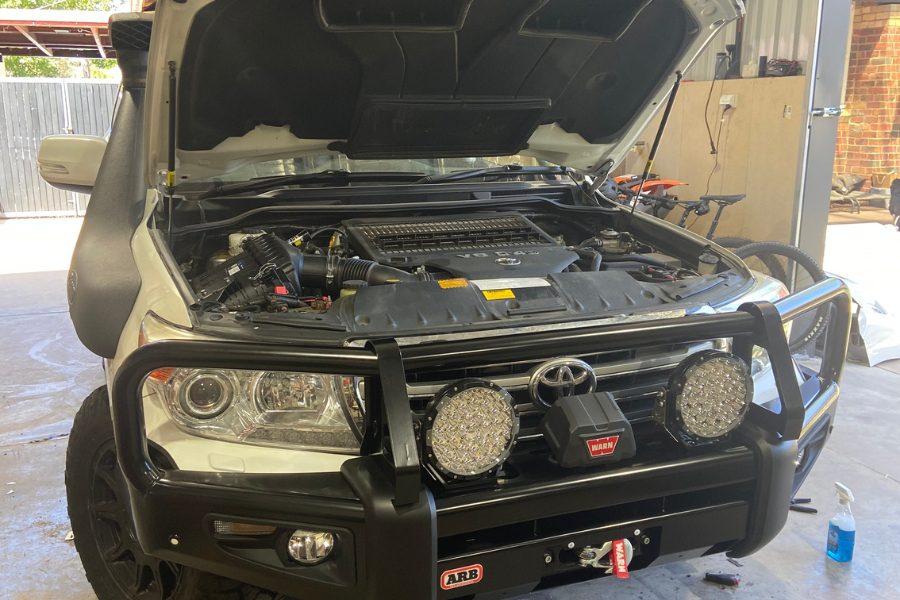
Front end complete in the workshop — ARB bar, Warn EVO 12S winch, customer-supplied 9-inch LED lights and Safari snorkel all on, hood up for final checks before handover.
We worked out a simple arrangement. Chris drove the 200 up and dropped it off. I ran him to the local train station, he caught the train home, and a couple of days later he and his wife drove up together to pick the vehicle up. They stayed a night or two in the area and made a weekend of it. That’s a model that works really well for distance customers — you turn the drive into a small trip rather than a chore, and the round-trip logistics actually become part of the experience rather than a hassle.
When Chris saw the finished car, he was stoked. It was exactly what he’d been planning, the brief was hit on every accessory, and he’d been kept in the loop the whole way along — no surprises at the end. That’s not a complicated thing to get right, but it’s the thing customers tell me has been missing at other shops.
Why the Relationship Matters More Than the Build
The story of Chris’s 200 Series is really a story about what happens when a small job is done properly. The first time he came to me it was just a Warn winch service on his old 100 — not a huge job. He came back when he was ready to upgrade vehicles. He drove past plenty of other shops to do it. That’s what aftercare and trust actually look like in practice over multiple years and multiple vehicles.
Front end complete in the workshop — ARB bar, Warn EVO 12S winch, customer-supplied 9-inch LED lights and Safari snorkel all on, hood up for final checks before handover.
If you’ve done your research, you know roughly what you want, and you just want one bloke to listen to what you actually do with the vehicle and quote you straight — that’s what I’m here for. Doesn’t matter whether you’re up the road in Strathfieldsaye or down in Geelong like Chris. The 4WD accessories and fitouts page covers what’s involved in a build like this one, and the winches page has more detail on the Warn range if a winch is on your list. If you’re weighing up battery options, the article on AGM vs lithium for touring builds is worth a read before you commit either way.
The 200 Series Build in Pictures
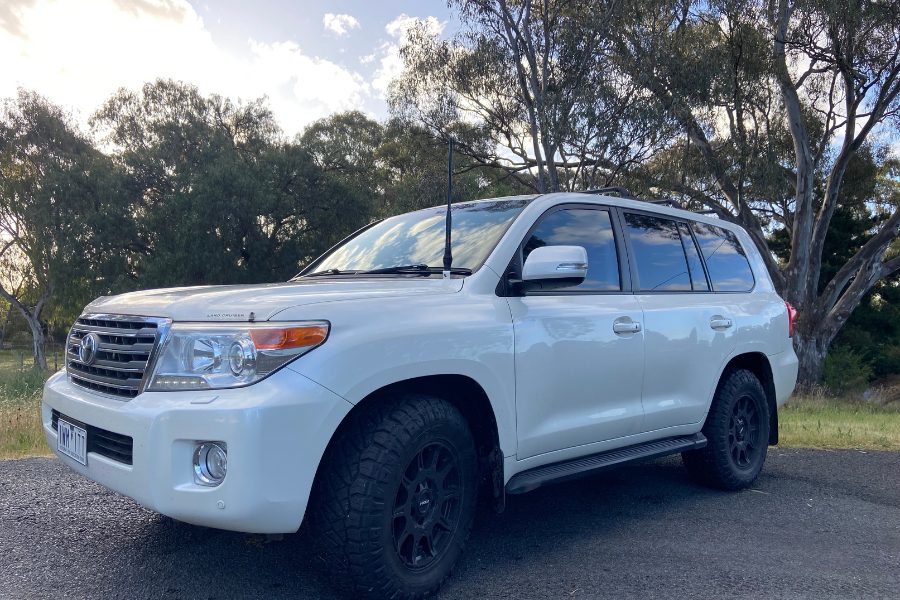
Workshop shots and finished detail from Chris’s 200 Series touring fitout.
Build Spec — Chris C's 200 Series Touring Fitout
Bull Bar
ARB Deluxe Big Tube (pre-Summit model) — retains factory headlight washers and park sensors
Recovery Points
Dual Rated ARB Recovery Points — fitted in conjunction with ARB bull bar
Winch
Warn EVO 12S — 12,000lb capacity, mounted to ARB bull bar cradle
Driving Lights
9″ LED driving lights (customer-supplied) — bar-mounted on standard ARB light tabs
Air Intake
Safari Snorkel + Donaldson Airbox Upgrade
UHF Radio
GME UHF Radio with XRS + GME aerial
Dual Battery
Under-bonnet dual battery setup
Rear Storage
MSA Rear Drawers — twin drawer system with LED interior lighting
Roof Rack
ARB Base Rack — factory Toyota roof bars removed as part of fit
Vehicle
Toyota LandCruiser 200 Series (earlier model)
Customer
Chris C — Geelong, VIC
Build Type
Touring Fitout
Frequently Asked Questions
Real questions 200 series owners ask us at MBC 4X4 Solutions
Is it worth fitting out an older 200 Series LandCruiser?
Yes, and Chris’s build is a good example of why. An earlier-model 200 Series in solid condition, properly set up with quality accessories, becomes a ten-to-fifteen-year touring platform. The 200 is parts-accessible, mechanically proven and gives you a real V8 LandCruiser base for a serious build. Once the bar, snorkel and drawers are on, you’re not buying for resale anymore — you’re building a vehicle you intend to keep.
Does the ARB Deluxe Big Tube bull bar retain the factory park sensors and headlight washers on a 200 Series?
Yes. The ARB Deluxe Big Tube bar fitted to Chris’s 200 Series was specifically chosen because it accommodates and retains the factory Toyota headlight washers and front park sensors. Not every aftermarket bar manages both, so it’s worth confirming at the quote stage. On this build it was part of the pre-qualification conversation before the job was booked.
Why fit a Donaldson airbox upgrade alongside a Safari snorkel on a 200 Series?
The 200 Series has a known weakness with fine dust ingestion. A snorkel relocates the intake to roof height where the air is cleaner, but it doesn’t fix what’s happening downstream at the airbox seal. Pairing a Safari snorkel with a Donaldson airbox upgrade addresses the source of the problem and significantly extends filter service intervals — the right combination for serious dust-country touring.
Can MBC 4X4 Solutions fit out my 4WD if I'm not local to Bendigo?
Yes. Chris is from Geelong, about two and a half hours south of the Bendigo workshop. He dropped the 200 Series off, I ran him to the local train station, and he and his wife came back together a couple of days later to pick it up and made a weekend of it. Distance customers are common and the logistics are straightforward — a road trip up is usually a sensible call when you can’t find a fitter you trust closer to home.
What happens to the factory Toyota roof bars when an ARB Base Rack is fitted?
The factory roof bars come off as part of the Base Rack install on the 200 Series — that’s standard for this rack and it sits much tidier than trying to retain the factory crossbars. It’s discussed and confirmed at the quote stage, so it’s not a surprise on the day. The result is a low-profile platform with no wind noise from factory bars, and a proper load surface for touring gear.
Written by Mitchell Cox — Owner / Operator, MBC 4X4 Solutions
Cert III Automotive Mechanical. Fifteen years in the 4WD industry, including ten years at ARB Bendigo. Every build quoted, fitted and handed back by the same bloke.
Build credit: Chris C — Geelong, VIC. Images published with the vehicle owner’s permission. Customer first name and location only — no last name or personal address published per MBC public messaging guardrails.
Whether you’ve got a full list like Chris or you’re starting from scratch, I’ll have a straight conversation about what makes sense for your vehicle and your budget, and quote it without the run-around. I’m by appointment with flexible booking times, so interstate and distance customers are always welcome — happy to work out the logistics the same way I did with Chris.
Planning a Touring Build on a 200 Series or Similar?
If you’ve got a 200 Series — or any serious tourer — and you want it set up properly the first time, get in touch.
More Recent Builds from the MBC Workshop
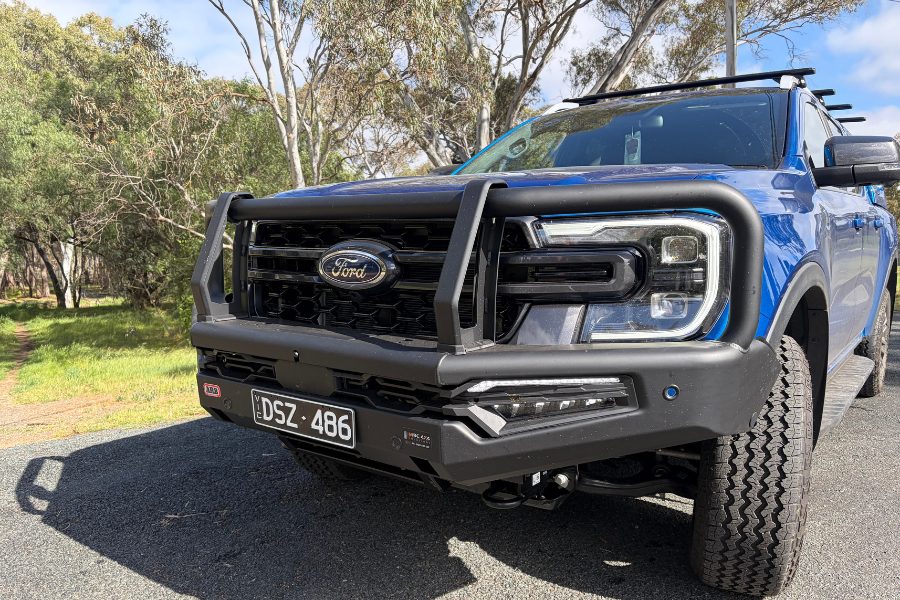
Other Ranger fitouts, family + tradesman builds and ARB accessory installs off the MBC bench.
Building Something Similar on your 4WD?
Tell Mitch what you’re after. Same bloke quotes it, sources it, fits it and stands behind it. Servicing Bendigo and Central Victoria — distance customers welcome.